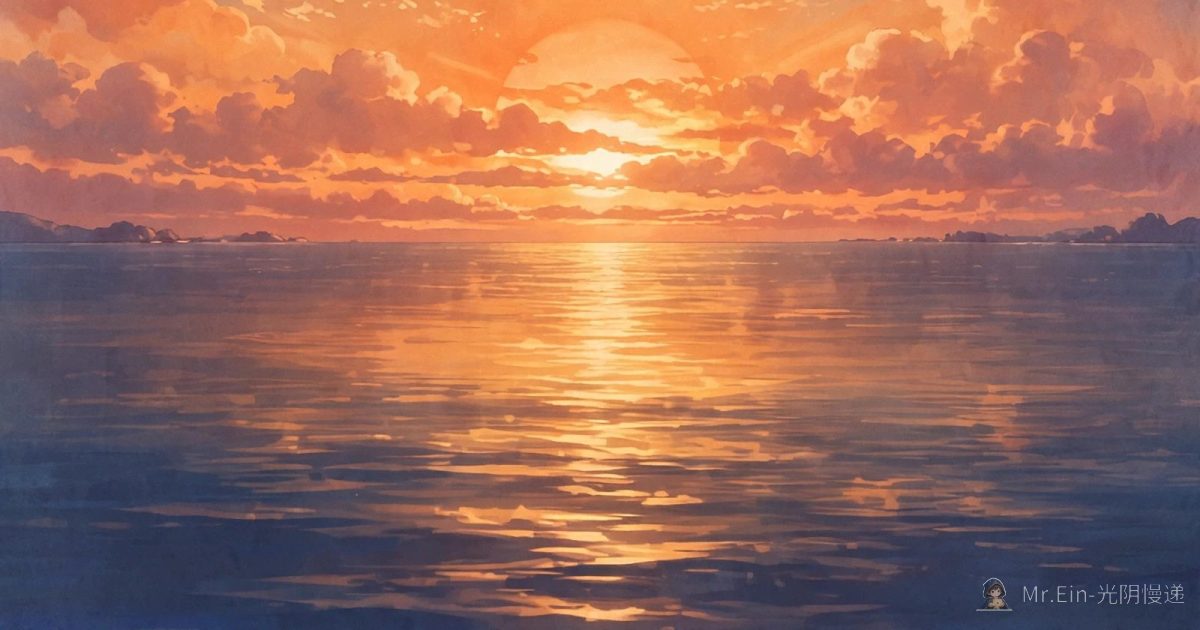
I have always wanted to take the train to the sea. Not a fast train, but a slow one, the kind that stops at small stations with names I cannot pronounce. Through the window the fields give way to hills, the hills to a river, and then, all at once, there is the sea, flat and bright to the horizon. I think about that journey often, especially on grey days. Perhaps the point is not the sea itself, but the willingness to go and see it.
The garden after rain smells different from anything else, all wet earth and crushed leaves and something green I cannot name. I walk out in my slippers, not caring about the mud, and check on the plants I thought the storm might have hurt. They are fine. They are better than fine, standing a little taller, shaking the water off their leaves. Gardens forgive a lot, if you give them time.
Night owls get a bad reputation, but the night has its own gifts. After midnight the messages stop, the street goes quiet, and the world narrows to the circle of lamplight on the desk. That is when I write best, when the day’s noise has settled and the thoughts I could not hear in daylight finally speak up. I know I should sleep earlier. But some part of me will always love this hour, when the house is dark and the page is bright.
A song on the radio can change the whole feeling of a drive. One minute the road is just a road, and the next it is a scene from a film I have never seen, with the fields rolling past and the light doing something golden. I turn the volume up a little and sing along badly, and for three minutes everything is exactly as it should be. Music has this power, and it asks for nothing in return.
The last train home is always quieter than the ones before it, full of people who stayed a little too long at dinner or at work. Nobody talks much. Heads rest against windows, books lie open on laps, and the city slides past in long ribbons of light. I like this train. It feels like the whole carriage has agreed, without saying so, to give each other a little peace before the day ends.
Morning light on the windowsill is the first thing I notice when I wake up, a thin gold line that grows wider as the minutes pass. I do not get up right away. I lie there and listen to the building wake up: water running somewhere, a door closing softly, a child laughing in the flat below. It is an ordinary morning, and that is exactly what makes it good. Ordinary mornings are easy to overlook, but they are the ones that hold everything together.
The old photograph was taken the summer I turned ten, on a beach I can no longer name. Everyone in it is laughing, even the dog, and the light is the kind of gold that only exists in late August. I keep it on my desk now, not because I miss that summer, though I do, but because it reminds me that happiness is often simpler than we make it. Sun, sea, and people you love. That is the whole list.
There are letters I never sent, kept in a drawer, written on nights when I had more feelings than words. Some were angry, some were grateful, and most were simply honest in a way I was not brave enough to be out loud. I read them sometimes, and I am glad I never sent them, and a little sad, too. A letter you never send is still a conversation, just one you have with yourself.
Twenty pages a day. That was the promise I made to myself at the start of the year, and it sounded almost too small to matter. But small things add up. A month later I had finished a book I had owned for three years. A year later, the shelf looks different, and so do I. Reading is not a race; nobody gives a prize for finishing first. The real reward is quieter: a sentence that stays with you, a way of seeing that was not there before.



评论(0)
还没有评论,快来写下第一条吧。